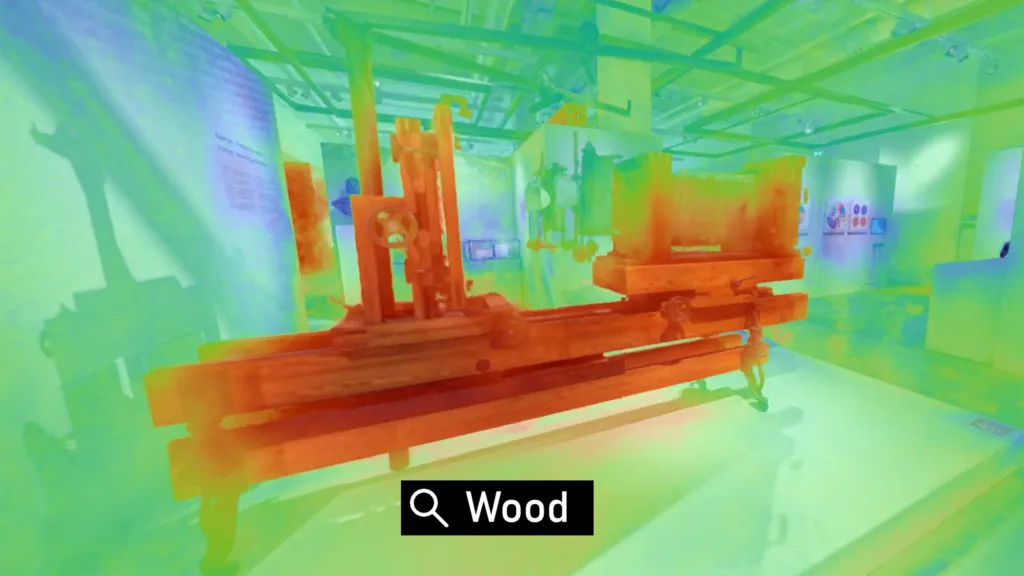
Spatial search
Query a scene in natural language — wood, metal, glass — and get a relevance heatmap of matching objects and materials.
Orchestrating agents that can actually get work done.
Our research focuses on making multi-agent systems dependable in production. That means disciplined tool use, recoverable failure modes, and evaluation methodology that scales beyond one-shot benchmarks. We contribute back to open-source and publish where we can.
AI agents are software systems that take on tasks the way a human specialist would: they act autonomously, make decisions, and use tools to get there. Today they already handle work in marketing, sales, software development, data acquisition, and analysis.
Instead of building one super-brain agent, we compose teams of specialized agents. A collection of focused experts solves tasks more efficiently — and more reliably — than a single monolithic model.
Every agent runs on a foundation model with clear role instructions, a persona, and context. Agents access background tools and wait for instructions from an AI orchestration layer — while humans stay in control and initiate commands from the outside.
Human operator
AI orchestrator
AI agents
Tools
Our S-Agent is a spatial-intelligence agent in development that brings real-world spatial data into agentic systems. It already reconstructs rooms in 3D, finds objects and materials, and separates scenes with segmentation masks. Next up: deeper spatial understanding and intuitive physics, fully compatible with multi-agent setups.
Three core capabilities power the S-Agent today.
Query a scene in natural language — wood, metal, glass — and get a relevance heatmap of matching objects and materials.
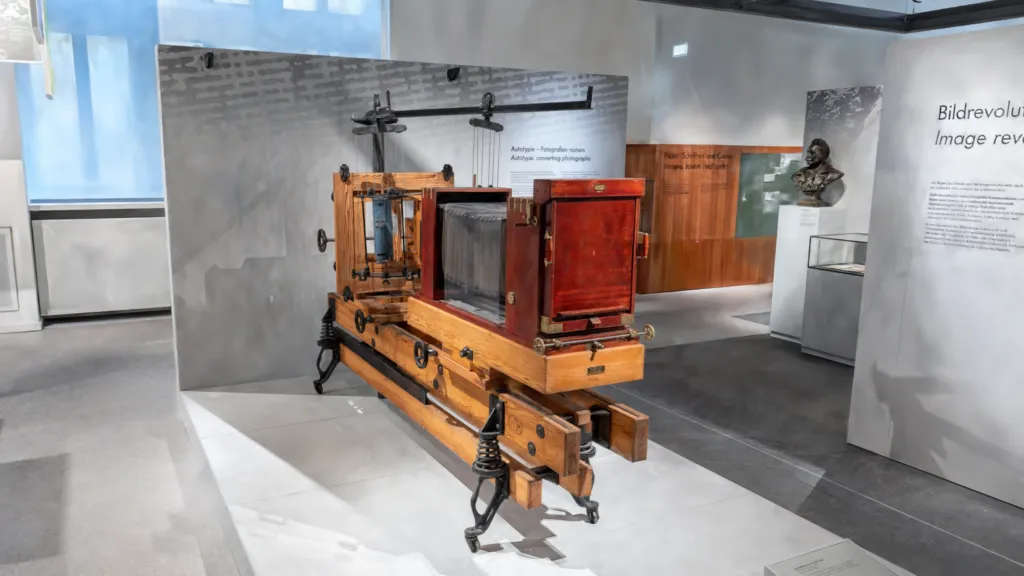
Photorealistic 3D reconstruction of real environments as the foundation for search, measurement, and simulation.
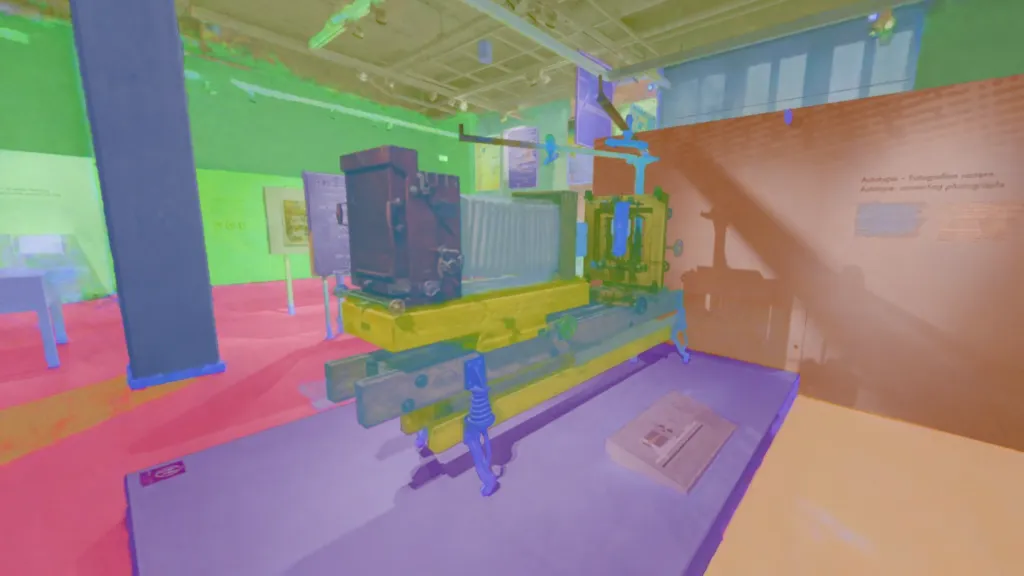
Segmentation masks split a scene into objects and regions, so agents can reason about the parts — not just the pixels.
Spatial memory means remembering and using information about the physical environment — Spatial Information Retrieval (SIR) that enhances your LLM applications.
Inference
S-Agent
Data acquisition & retrieval
Images & video
Book a free 30-minute call. We analyze your company's potential quickly and reliably.